
AdaptAI
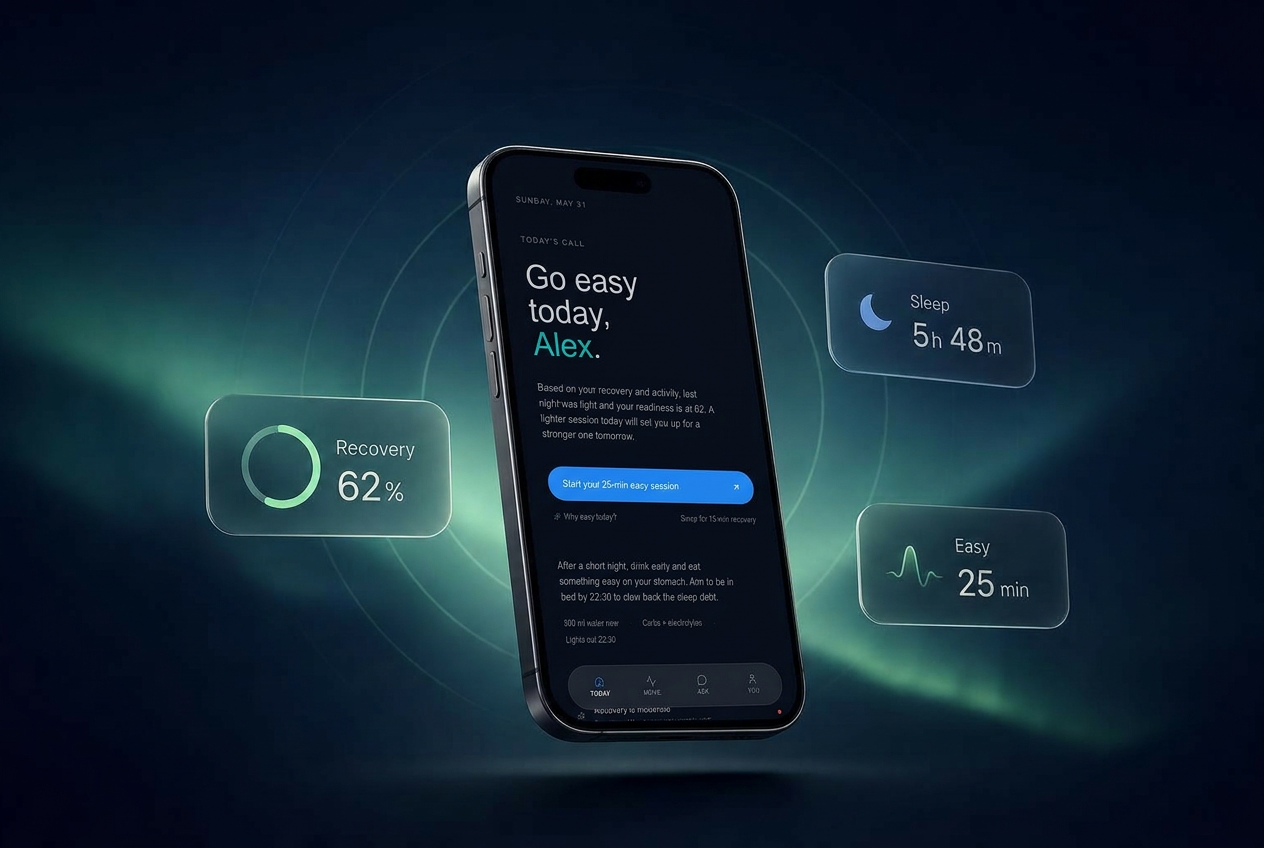
An AI-powered fitness platform that continuously adapts workouts using recovery, sleep, stress, alcohol intake and behavioural patterns instead of fixed fitness plans.
- Role
- Product Designer · UX Designer · AI-Assisted Builder
- Timeline
- Concept Project
- Team
- Solo
- Category
- Enterprise AI · Adaptive Fitness Platform
- What it is
- An adaptive fitness companion that recalibrates plans, recommendations and recovery around real behavior.
- Who it's for
- People who fall off rigid fitness plans - busy professionals, returning athletes, anyone whose week rarely goes as scripted.
- Core interaction
- Sense → Adapt → Suggest → Reinforce
- Built with
- Product design + behavioral framing + AI-assisted prototype.
The problem this product set out to solve.
What people faced
Most fitness apps assume an ideal user - one who sleeps eight hours, never misses a workout, recovers on schedule, and follows a 12-week plan to the day. Real humans miss sessions, sleep badly, travel, get sick, lose motivation and recover unevenly. The moment the plan stops fitting, the product stops being useful, and the user blames themselves.
The landscape
The category has spent a decade getting better at tracking - rings to close, streaks to defend, charts to chase. Tracking generates data but rarely changes behavior. Wearables already capture sleep, heart rate, strain and steps; the missing layer is a product that reads those signals and quietly does something about them.
Why it matters
Consistency, not intensity, decides long-term outcomes. The opportunity isn't another logging surface - it's a product that protects consistency by absorbing the messiness of a real life into the plan, instead of breaking on contact with it.
Understanding behaviour before designing experiences.
Rather than designing another workout tracker, I wanted to understand why people struggle to stay consistent with fitness routines and how AI could adapt recommendations based on real-life behaviour instead of rigid plans.
Competitive Analysis
Reviewed leading fitness platforms including WHOOP, Oura, Apple Fitness, Garmin Connect, Fitbit and MyFitnessPal to identify behavioural gaps.
User Survey
Collected quantitative feedback from users about workout consistency, recovery awareness and habit formation.
Behaviour Research
Reviewed sports science research on sleep, recovery, alcohol, stress and exercise adherence.
Problem Framing
Mapped recurring behavioural patterns and identified opportunities for AI-driven intervention.
Design Principles
Converted research into product principles that guided every recommendation and interaction.
Discovery focused on the behaviour behind the workout - understanding why adherence breaks down before deciding what the product should do about it.
Research & Validation.
Quantitative signals from a user survey, qualitative insight from fitness professionals, and a behavioural literature review converged on a single direction: adapt the plan to the human.
Mixed-experience users across consistency, recovery and habit-formation questions.
WHOOP, Oura, Apple Fitness, Garmin, Fitbit, MyFitnessPal and others.
Coaches and trainers who work with adherence and recovery daily.
World Health Organization and American College of Sports Medicine guidelines.
Key Research Insights
Users wanted workouts that adapt daily instead of following fixed weekly plans.
Ignored recovery even when wearable devices suggested resting.
Did not understand how alcohol impacted recovery and workout performance.
Preferred one unified dashboard instead of checking multiple health apps.
Most Common Fitness Challenges
- Inconsistent Workout Routine83%
- Poor Recovery Awareness76%
- Difficulty Staying Motivated73%
- Poor Sleep Habits69%
- Overtraining61%
- Information Overload54%
Where AdaptAI sits in the category
| Capability | Strava / Whoop | Apple Fitness+ | Future / Centr | AdaptAI |
|---|---|---|---|---|
| Tracks behaviour | ✓ | ✓ | ✓ | ✓ |
| Adapts plan to recovery | ✓ | |||
| Recovery as a destination | ✓ | |||
| AI explains every adjustment | ✓ | |||
| Single daily call, not a feed | ✓ |
What users actually said
I miss one Monday and the whole week feels broken.
It tells me what I did. It never tells me what to do today.
On a bad night of sleep I'd love it to just lower the bar for me.
Research Takeaways
Behaviour changes faster than fitness plans.
Plans built for a person's best week stop fitting by the third hard day - adaptation has to happen at the cadence of real life.
Recovery is often ignored despite being the strongest predictor of performance.
Users only protect recovery when the product treats it as a completable, visible state rather than the absence of a workout.
Users trust AI recommendations more when the reasoning is transparent.
Every adaptation needs a one-line, plain-language reason - trust collapses the moment the system stops explaining itself.
Research validated a single direction: AdaptAI should interpret behaviour, adapt the plan, and explain itself - in plain language, every day.
The behaviour patterns that shaped the product.
Four signals from the survey reframed the brief - the product had to adapt to behaviour, treat recovery as a first-class state, explain alcohol's impact, and consolidate the dashboard.
83%
Users wanted workouts that adapt daily instead of following fixed weekly plans.
76%
Ignored recovery even when wearable devices suggested resting.
71%
Did not understand how alcohol impacted recovery and workout performance.
67%
Preferred one unified dashboard instead of checking multiple health apps.
Behaviour - not workouts - is the product. Every surface is designed to lower the cost of showing up on the days a fixed plan would punish the user instead.
The principles that guided every decision.
Behavior Before Features
Adherence is the only fitness metric that matters at scale. Every surface is designed to lower the bar on hard days so people actually keep showing up.
Calm by Default
No streaks, no shame, no red flames. The product's tone stays brief and on the user's side - especially on the mornings when motivation is at zero.
Recovery as Training
Rest is reframed as a completable session, not the absence of one. Treating recovery as a destination unlocked the rest of the product.
Explain Every Adaptation
When the system swaps a workout, it says why - in one short line. Adaptive systems lose trust the moment they stop explaining themselves.
The calls that shaped the product.
Four product calls did more to shape Auto Aware Fit than any visual decision. Each one started from a specific failure mode in mainstream fitness apps, and each one cost something in return.
Adapt the plan, don't blame the user
When a user misses sessions, sleeps badly, or falls behind, most apps respond with louder reminders, broken streaks and red dots. The product becomes a source of guilt at exactly the moment the user is most likely to quit.
Treat every off-pattern signal - short sleep, low steps, missed session - as input to the plan, not as a violation of it. Volume drops, intensity moderates, recovery is offered. The product never accuses; it adjusts.
Adherence collapses when users feel judged. The product earns trust by being on their side on the worst days, which is when category competitors lose them.
One daily call instead of a dashboard
Fitness dashboards present dozens of metrics and ask the user to interpret them. Most users don't want data - they want to know what to do today.
The home surface is a single language-led recommendation: 'Go easy today, Alex' - with a 25-minute easy session, a one-tap swap to recovery, and a short explanation of the readiness signals behind it. Data lives below, on demand.
Decision fatigue is the silent killer of fitness habits. The product carries the decision so the user doesn't have to assemble one from a wall of charts.
Recovery as a destination, not a label
Most apps treat rest days as the absence of training - an empty cell on the calendar - which reads as failure to a user trying to build a habit.
Recovery has its own surface with three prescriptive, well-timed actions (hydrate now, eat at 12:30, lights out at 22:30) and its own confirmation: 'Aligned day · 12 in a row.' Rest counts as showing up.
Reframing recovery as an active, completable state makes consistency possible across the full week - not just on the days the user feels like training.
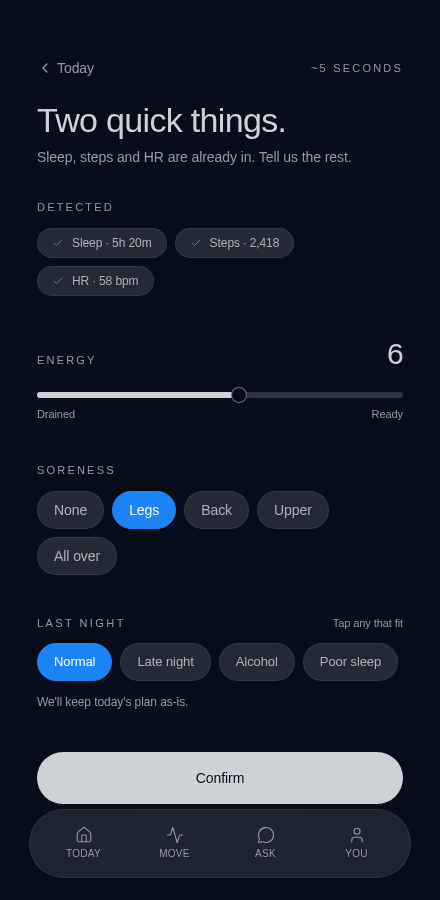
A 5-second check-in over a 5-minute survey
Subjective inputs (energy, soreness, last night's quality) are critical to good prescription, but every minute the user spends entering them is a minute the product is losing them.
Pre-fill what the sensors already see (sleep, steps, HR), then ask only for what they can't - energy as a slider, soreness as a chip group, last night as one tap. Five seconds, end to end.
Effort is a tax on adherence. Every input the product extracts from a device is one the user doesn't have to type - and the product still gets the signal.
AI Decision Engine.
Unlike traditional fitness apps that rely on fixed workout schedules, AdaptAI continuously evaluates multiple behavioural and health signals before recommending the best action for the day. The goal isn't simply to maximise today's workout—it is to maximise long-term consistency, recovery and sustainable progress.
Decision workflow
- Sleep Duration
- Recovery Score
- Heart Rate Variability
- Resting Heart Rate
- Workout History
- Alcohol Intake
- Stress Level
- Calendar Availability
- Weather Conditions
AI Behaviour Engine
- Analyse Recovery
- Detect Fatigue
- Identify Behaviour Patterns
- Predict Readiness
- Prioritise Long-Term Consistency
- Today's Workout
- Training Intensity
- Recovery Recommendation
- Hydration Goal
- Nutrition Reminder
- Mobility Suggestion
- Rest Day Recommendation
Transparent AI
Every recommendation comes with a reason.
Users trust AI more when they understand why a recommendation was made. Instead of behaving like a black box, AdaptAI explains the behavioural signals behind every recommendation.
Confidence is calculated from the completeness and consistency of available health signals.
AdaptAI recommends prioritising recovery today because multiple behavioural signals indicate accumulated fatigue. A lower-intensity mobility session will improve long-term consistency while reducing injury risk and preparing the body for tomorrow's workout.
Why users trust AdaptAI
Explainable AI
Every recommendation clearly explains the signals influencing the decision.
Confidence Score
Users understand how confident the AI is before following a recommendation.
Human Override
Recommendations are suggestions, not commands. Users remain fully in control of every decision.
“The goal isn't to maximise today's workout. It's to maximise tomorrow's consistency.”
Key screens and experience flow.
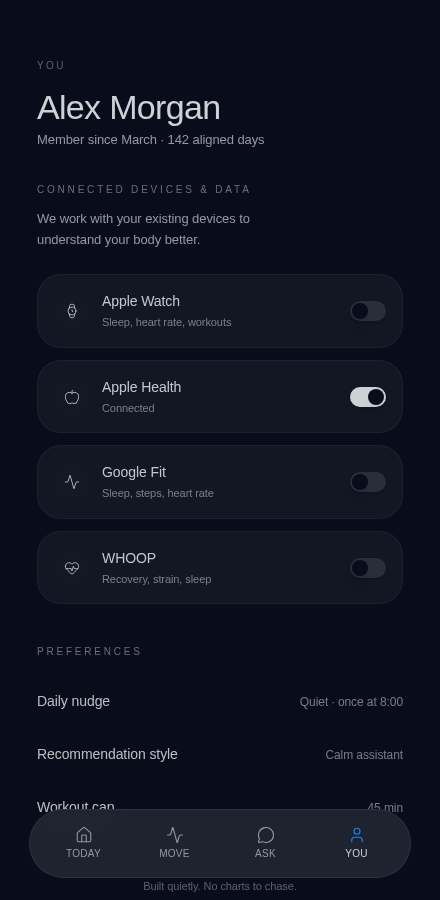
Personalization in Auto Aware Fit isn't a setting - it's the product's default behavior, driven by signal, framed in language, and visible at every step. The screens lead; the explanation supports.
Sense - signals come in continuously
Sleep, steps, heart rate and workout history are read from whichever devices the user already owns - Apple Health, Apple Watch, Google Fit, WHOOP. Nothing is asked for that the phone can already see.
Interpret - readiness is computed in plain language
Raw signals collapse into a readiness score and a small set of human-readable facts: 'Recovery is moderate · readiness 62', 'Only 5h 20m sleep last night', 'You moved less yesterday'. The product narrates its own reasoning before recommending anything.
Recommend - one call, with the reason attached
Based on readiness, the engine picks a session shape (easy, full-body lighter, recovery) and a duration that fits the user's workout cap and historical pattern. The recommendation is explained, not just delivered.
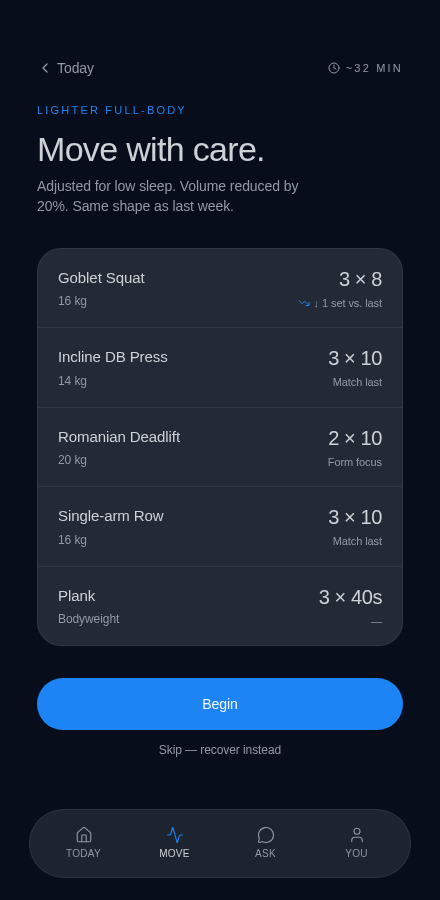
Adapt - the user can swap without breaking the plan
Any recommendation has a one-tap alternative ('Swap for 15-min recovery'). Swapping isn't a failure; it's a signal that feeds the next day's adaptation. The plan stays whole.
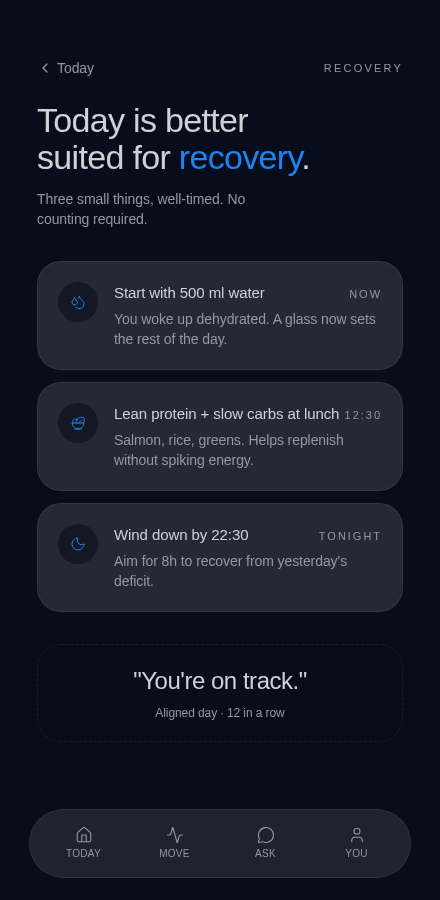
Reinforce - habits get named and celebrated quietly
Consistency is reflected as 'Aligned day · 12 in a row' and 'Member since March · 142 aligned days' - language that rewards showing up, not output. No charts to chase, no rings to defend.
Visual design system.
The visual system is intentionally quiet so the daily call carries the weight. A deep navy canvas, a single confident accent, generously spaced type, and language that reads more like a calm coach than a fitness brand.
Palette & semantics
Scale & voice
Reusable building blocks
Daily Call Card
Language-first hero on the home surface. One recommendation, one primary action, one swap, one explanation.
Adaptation Annotation
Every adjusted plan carries a one-line, plain-language reason: 'Adjusted for low sleep · Volume reduced by 20%.'
Signal Chips
Compact, sensor-sourced facts (sleep, steps, HR) with a confidence dot - green steady, amber soft warning, red attention.
Recovery Step
A timed prescriptive action (Now / 12:30 / Tonight) - completable, never punitive.
Ask Pulse
Unified companion entry that answers 'why is today like this?' in the product's own voice.
Designed to include
- High-contrast surfaces, all interactive targets ≥ 44pt.
- Voice and tone calibrated to coach, not command.
- Critical adaptations explained in plain text, never colour alone.
- Reduced-motion respected across the daily call and recovery animations.
- Single primary action per surface to reduce cognitive load on low-energy days.
AI-assisted design process.
AI plays two jobs in Auto Aware Fit. Inside the product, it reads the user's signals, interprets them in plain language, and adapts the plan around them. Outside the product, AI-assisted development is how I - a designer, not a software engineer - closed the loop from a behavioral concept into a working prototype I could feel on a real day.
What it actually took
AI inside the product · adaptive coaching
The engine reads sleep, recovery, activity and check-in inputs, fuses them into a readiness signal, and adapts the day's recommendation around it. Every adjustment ships with a one-line, plain-language reason so the user understands the why, not just the what.
AI inside the product · Ask Pulse companion
A calm conversational layer that answers 'why is today a recovery day?', 'can I still work out lightly?', 'what should I eat today?' in the product's own voice - grounded in the same signals the daily call used.
AI in the build process · behavior to working prototype
I directed AI as a pair - describing the behavior I wanted, reviewing implementation, refactoring with intent. My job stayed product design; the code became a conversation about behavior, not syntax. A behavioral model in a doc is a hypothesis; running on a phone, it's a product.
AI in the build process · rapid experimentation
Each loop was hours, not weeks. I shipped, used the product overnight, noticed what felt off in my own behavior, and rebuilt the surface the next morning. The build cycle became the user-research cycle.
What building taught the design
Pacing, copy, default states and empty states carried more weight than I'd assumed from design alone. The product's voice - calm, brief, on the user's side - only became real once it had to ship in working code on a low-sleep morning.
“Design that can't be felt is just a hypothesis. AI-assisted building let me test the hypothesis the same week I had it - without leaving the craft of being a designer.”
Success metrics.
Auto Aware Fit demonstrates a fitness product that does what the category usually doesn't: it interprets behavior instead of tracking it, adapts plans around recovery and real life, and uses AI to personalize each day in plain language. The outcome is a model - adaptive fitness planning, behavior-driven recommendations, recovery-aware decision-making, AI-powered personalization, and habit formation that survives the bad weeks - that other consumer health products can borrow from.
What I took away
- Adaptation, not tracking, is the unlock - a product that interprets behavior keeps users when a tracker loses them.
- Recovery-aware planning is the single biggest behavioral lever; reframing rest as a completable session changed every other surface.
- Behavior-driven recommendations only earn trust when the AI explains its reasoning in one short, plain-language line.
- Habit formation survives bad weeks only when the product is willing to lower the bar before the user has to.
- AI-powered personalization isn't a setting - it's the product's default behavior, expressed as language the user can argue with.
What worked and what I'd improve.
- - Reframing recovery as a completable session was the single biggest behavioral unlock.
- - Compressing the daily decision to one call kept the product calm on the user's worst day.
- - Letting the engine explain itself out loud kept adaptations from feeling arbitrary.
- - Long-arc personalisation - learning individual baselines, swap patterns and recovery rhythms over months.
- - Smarter override learning so the engine understands why a user swapped, not just that they did.
- - Real-world testing with people in the middle of a broken week, where the product earns its place.